The AllScan UCI160 is a professional-grade USB Radio Interface supporting a wide variety of features, including all those in the URI125 and URI142, while integrating a USB-UART serial IC for compatibility with all known OS's, Radio-Over-IP (ROIP), digital mode, data, and remote rig control applications. The URI160 supports HTs and mobile radios, CM108 GPIO3 or UART RTS PTT control, routing of COS to CM108 VolDn or to CTS or DCD, active high or low COS, CAT control and HT serial programming, a 3.5mm TRRS serial port (TTL levels), a user-configurable 3.5mm TRRS jack, and a 5V 1A output to power HT(s) or other devices, which can be switched Off, On or Auto (controlled by DTR or CM108 Status). Supports all known ROIP/data applications from AllStar to Zello. All K1 and Mini-DIN-6 lines can be used simultaneously with no need to switch cables or reconfigure anything. 2.9" x 1.1" x 3.2" extruded aluminum enclosure
Schematic (Main Board) /
Schematic (Mezzanine Board)


Enclosure size: 2.9" x 1.1" x 3.2"D (74x29x80mm). Click images to enlarge
Introduction
A USB Radio Interface can be as simple as a USB audio interface with some extra I/O lines to support PTT and COS. In the past people have used ~$2 CM108 sound fobs and had good results for basic AllStar nodes in low-RFI environments. Modifying a sound fob is not trivial though as it requires soldering fine wires to PTT and COS lines on very small pins of a surface-mount IC, and several other modifications. The result is then a board with a bunch of wires hanging off which is not a professional-grade or long-term solution. Some sort of an enclosure would be nice, along with some I/O jacks and LEDs. Rather than reinvent the wheel, it makes more sense to go with an off-the-shelf solution that has already been extensively optimized for performance, flexibility and cost-effectiveness.
When I started building nodes in 2022 I first used CM108 fobs and used and tested them in just about every possible configuration. I quickly discovered their extreme limitations in regards to RFI-resistance – which cannot be fully remedied even with the most extensive modifications. Most AllStar nodes in the past have been either low-power simplex nodes or nodes that use a mobile radio, neither of which typically create high levels of RFI near the URI itself. My goal in 2022 however was to build the highest-performance yet lowest-cost cross-band full-duplex node possible, which after years of R&D I perfected in early 2025. In 2023-24 I had also tried URIs from multiple other makers, but none of them were able to provide the necessary level of RFI-resistance to achieve a true simple plug&play solution for cross-band full-duplex HT nodes – where you have multiple HTs transmitting 1+Watts as little as 6" away from the URI.
AllScan URIs have a number of circuitry and PCB layout optimizations that took me over a year of R&D to achieve. The result is higher RFI-resistance and equal or better audio quality in all use cases than any other URI. All other URI's I know of fail to follow even the most basic grounding and power supply separation recommendations provided in C-Media's own documentation. These other makers clearly did not invest much time into refining their product designs - which look very dated and have only the most basic features and I/Os, while I have continued to innovate, with the result being the introduction of the URI160 in November of 2025.
As evident the front and back panel pictures, the URI160 has 7 I/O jacks, 7 slide switches, 6 tri-color status LEDs, and 2 level trimmers, all on the front and back panels of a compact, robust and rugged enclosure that's only 2.9"W x 1.1"H. It is clearly on a whole different level than any previous URI. AllScan PC Boards are made in one of the world's most advanced fully-automated PCB fabrication and assembly houses, resulting in outstanding reliability and cost-effectiveness along with ultra-compact and efficient electronics.
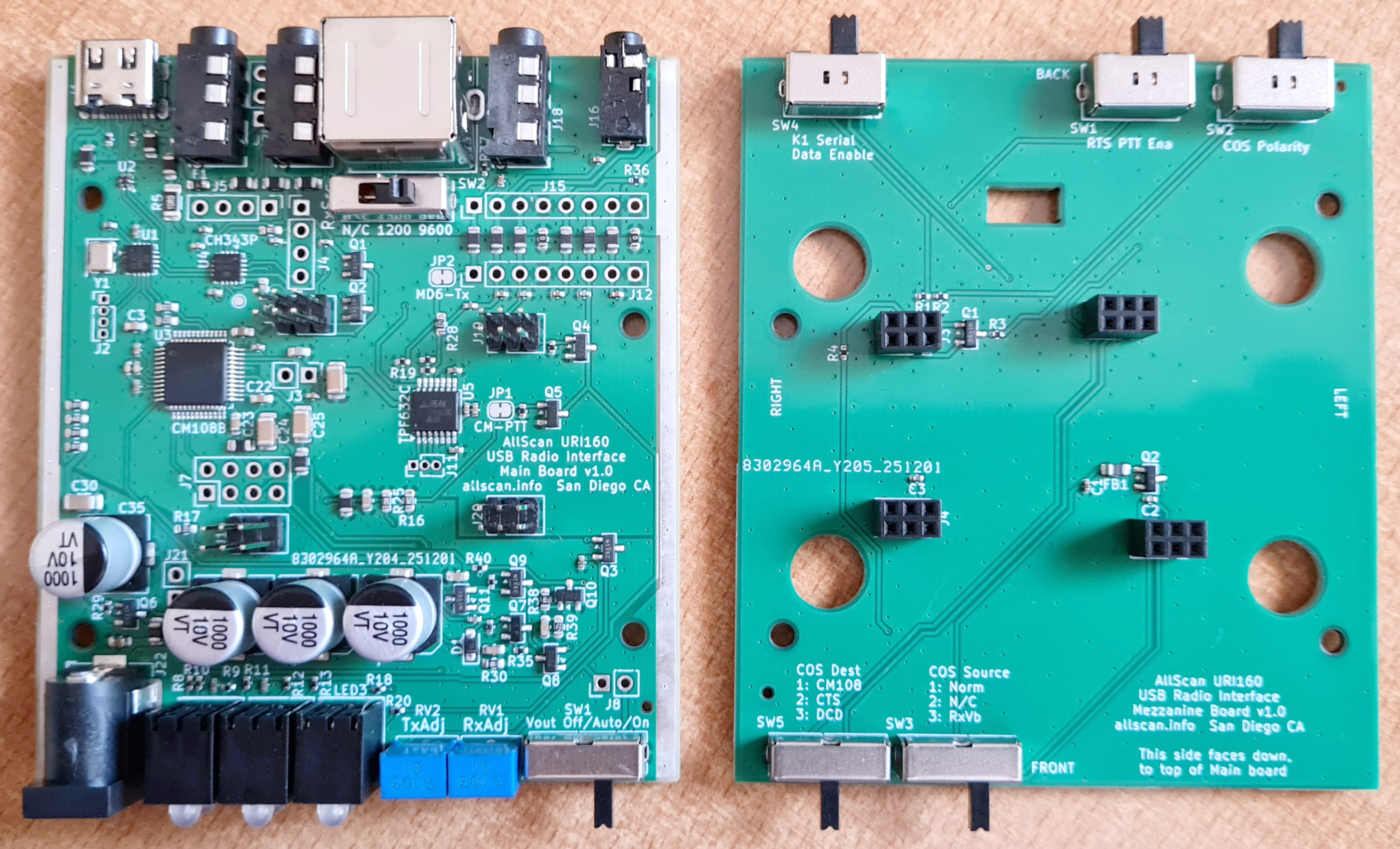
URI160 Main and Mezzanine PC Boards
My main product development goal is to create innovative full-featured products that support a wide range of applications. For example the AllScan URI125 integrates all functions of 2 previous products, the URI101 and URI110, resulting in a USB Radio Interface that supports multiple types of radios in the same form factor and around the same price point. This makes the choice of which product to get easier for buyers and simplifies inventory and configuration management.
URIs have generally been made specifically for AllStar, with various other apps over time gradually supporting the CM108/CM119 PTT & COS convention that AllStar defined (GPIO3=PTT, VolDn=COS). Many apps have not done this however, and there are some major limitations in supporting this on non-Linux OS's. In the case of Windows, for example if using the EchoLink app, the Windows HID service must be disabled to prevent COS from changing Windows' audio output levels. In addition EchoLink only supports CM108 PTT/COS in "SysOp" mode, currently requiring a separate EchoLink callsign to be set up (with -L/-R suffix). Other old USB radio interface designs such as SignaLink or RigBlaster also have major limitations, such as no support for a COS input at all - requiring the application to use VOX functionality which is not at all ideal for ROIP apps, and no support for CM1xx PTT, while being clunky and outdated.
Features & Innovations
The URI160 has a long list of features and industry-leading innovations:
- Supports all known ROIP apps including AllStarLink, DVSwitch, HamVOIP, EchoLink, and Zello, and works as a standard audio interface in Windows, Mac & Linux. Includes a C-Media CM108B IC, USB-C jack, and internal header pads for all Radio & CM108 I/Os
- Supports both HTs and mobile radios, or both at the same time eg. Rx on one band on an HT and Tx on another band with another HT or a mobile radio
- RFI filtering on all I/Os, optimized PCB layout with separate analog and digital power supplies and ground planes ensures extremely low noise and clear audio, even in very high RFI environments. Internal 10Ω–100μF RC filter on the analog supply and ¼Ω–4mF RC filter on the radio power supply. Extruded aluminum enclosure maximizes durability and EMI/RFI resistance
- 6 tri-color status LEDs show status of Power, USB Host Status, PTT, COS, ADC Clip, and Rx & Tx Serial Data. The Clip LED makes it quick and easy to set input levels and minimize any risk of ADC clipping
- Integrated USB-UART serial data IC enables RTS and/or CM108 GPIO3 PTT control and routing of COS to the CM108 or to CTS or DCD, thereby supporting all known ROIP apps as well as CAT control and HT serial programming via the K1 jacks or via the 3.5mm TRRS serial port. The integrated CH334P USB Hub and CH343P USB-UART ICs are plug&play with Windows, Linux and likely other OS's and should require no manual driver installation steps. Unlike other interfaces, both audio and serial data can be accommodated at the same time with no cables or settings needing to be changed, opening up interesting capabilities with HTs that support CAT control
- 5V 1A output to power HT(s) or other devices, which can be switched Off, On or Auto (controlled by DTR or CM108 status line). No other interface offers this capability, which required some out-of-the-box thinking and extensive filtering of the (typically very noisy) 5V USB supply. This enables nodes to be built with $15 HTs that provide a true long-term solution with no dependence on batteries, chargers or extra AC adapters or power supplies
- User-configurable 3.5mm TRRS jack that enables any internal I/O lines to be brought to the back panel, thereby making the URI160 even more flexible and adaptable
- 2 High-Speed USB 2.0 Downstream USB-C jacks are provided on the back panel, supporting a wide variety of USB accessories and making portable setups even more compact. The URI160 also works great for programming HTs with no separate cables needed
- Supports full and half duplex operation with no limitations. USB audio is independent of PTT/COS
- All configuration switches and trim pots are on the front and back panels, ensuring the enclosure does not need to be opened to change any configuration settings and making it quick and easy to switch between radios and/or applications
To sum it up, the URI160 is intended to do just about anything a USB Radio Interface could ever be expected to do. About the only feature the URI160 does not have is built-in audio isolation transformers, such as are present in the URI201. For properly configured systems isolation transformers are rarely necessary or helpful - if a radio or system has noise issues without isolation transformers this usually indicates issues such as ground loops, improper ground connections, improper EMC design, etc. which ideally should be addressed at the source. And if need be it's easy to get isolation transformers online for a few $ each and wire them into your cabling. The URI201 also provides a DB9 jack which can preferable for some installs, but DB9 jacks are significantly larger in size and would require the URI160 to have a larger enclosure size thereby increasing costs. Mini-DIN-6 jacks and cables provide a very solid and sturdy connection, and the User I/O TRRS enables 3 additional I/O lines of your choice to be made available on the back panel. The URI160 could also be provided in a custom version with an RJ45 radio connector, contact me for details.
Overview
The URI160's primary application is for use with AllStarLink but it can also be used with any other PC / smartphone / embedded / VOIP / ROIP application that would benefit from a high-quality interface to amateur and commercial radios.
The URI160 works with any Mini PC or RPi, is compact and portable, and provides commercial-grade audio quality, with CD-quality 90+dB audio SNR 16-bit 48KHz ADC and DACs. A MiniPC or RPi can be loaded with ASL3 and set up in as little as an hour. I do not recommend using anything with less than 2GB RAM or 8GB eMMC/SSD. Dell Wyse 3040's use only 2-3 Watts of power on average, are fanless yet run very cool and can be left running 24×7 with no noticeable effect on your electric bill.
All AllScan products are warranted against defects in materials and workmanship for 1 year from the date of original sale. Note however that the warranty does not cover damage to 2.5mm, 3.5mm or USB jacks.
For more information on how to set up AllStar see my How-To Guides. The documentation provided with the application(s) you plan to use should already provide clear instructions on how to connect a radio and what PTT/COS settings may be needed. There will usually also be many youtube videos and websites covering this for specific apps and radios. If you have any questions after consulting the application documentation and other online resources feel free to email me.
The URI160 does not alter the audio in or out and thus supports the full bandwidth of the CM108 ADC and DACs, supporting for example high-definition 16Ksps audio codecs that are available in higher-quality ROIP applications. Note that FM radios typically have usable frequency response well past 5KHz and thus ROIP and remote rig control applications for best audio quality should not use audio sample rates of any less than 16KHz.
The 2m & 70cm bands in most areas are highly underutilized, usually with only a few dozen repeaters that actually get significant use in most metro areas, and then maybe another few dozen packet/APRS channels, SSB/simplex channels, links, etc. In total, in a mid-size city like San Diego there are probably well under 60 channels active at any one time on an average day which multiplied by 25KHz equates to maybe 1.5MHz of spectrum being used out of the 34MHz between 144-148 and 420-450 MHz, ie. < 5% utilization. Thus there should generally be no need for "brick-wall" filters with ham nodes and repeater systems.
Radio flat audio (9600) inputs ie. that go direct to the FM modulator have very little if any filtering or limiting, thus care is required in setting input levels and ensuring the resulting transmitted audio actually sounds better than the mic (1200) input, and that the signal is not overdeviated or distorted and will not interfere with adjacent channels that might be in use. Confirming these details requires some expertise, thus mic level inputs should generally be used by default.
Refer to my How-To guide for mobile-radio AllStar nodes for details on recommended radios and config settings for ASL3
AllStarLink Setup Notes and Required Settings
ASL3 Clip LED Support
The URI160 supports the ASL3 ADC Clip Detect feature. To enable this be sure you are running ver. ≥3.0.5 and that you have the "clipledgpio = 1" line in simpleusb.conf/usbradio.conf. The ADC Clip Detect feature checks the raw ADC data stream for sequential clipped samples. If the Clip LED ever illuminates during normal use be sure to reduce the Mic Gain Adjust knob or Mic Boost switch settings and/or the Radio Rx level setting trimmers, or the ASL rxmix setting. AllStar audio levels should ideally have at least 3-6 dB of headroom between maximum audio levels and where clipping starts to occur.
Specifications
USB Audio IC
The CM108B USB audio controller/codec IC is a versatile and cost-effective USB audio solution providing CD-quality 16-bit 48Ksps audio (2 output channels and 1 input channel).
- The CM1xxB usable input range (supporting full ADC dynamic range) is -18 to 6 dBVrms, which corresponds to ASL rxmixerset values of 999 to 325, and IC mixer gain settings of 34 to 11 (1dB steps)
- CM1xxB ADC stated SNR is 90dB, DAC SNR is ≥93dB
- CM1xxB DAC ±3dB frequency response is 20–20K Hz
- CM1xxB ADC ±3dB frequency response is 100–20K Hz, but its response below 100Hz is usable and can support the lowest CTCSS tones
For more details see C-Media CM1xxx Spec Sheets.
Revision History / Schematic Notes
For schematics of earlier versions see the AllScan-Products GitHub repository. Note that the version number is shown on the PC Board. (The back panel version number refers to the top-level product assembly.)
Node Setup & Management
See the How-To Guides on the Main Page for details on how to set up an AllStar node. I highly recommend Dell 3040 MiniPCs and ASL3 along with my AllScan web app for managing node connections and favorites.
Full-Duplex Notes
Be sure to read the Full-Duplex Communication Benefits section in my How-To Guides for important notes on the benefits of full-duplex on AllStar.
Conclusion
The URI160 brings a entirely new level of features and flexibility to ROIP, remote rig control, digital mode and data communication apps. A thorough and uncompromising approach was taken in the URI160 development, resulting in a flexible platform that can accommodate a wide range of applications. For more info see the Products page.